

A SOP Template for IT Service Management provides a structured framework to standardize procedures, ensuring consistent and efficient delivery of IT services. It outlines key processes, roles, and responsibilities to enhance service quality and compliance with organizational policies. Utilizing this template helps streamline incident management, change control, and service request handling for optimized IT operations.
Incident Management and Escalation Procedures.
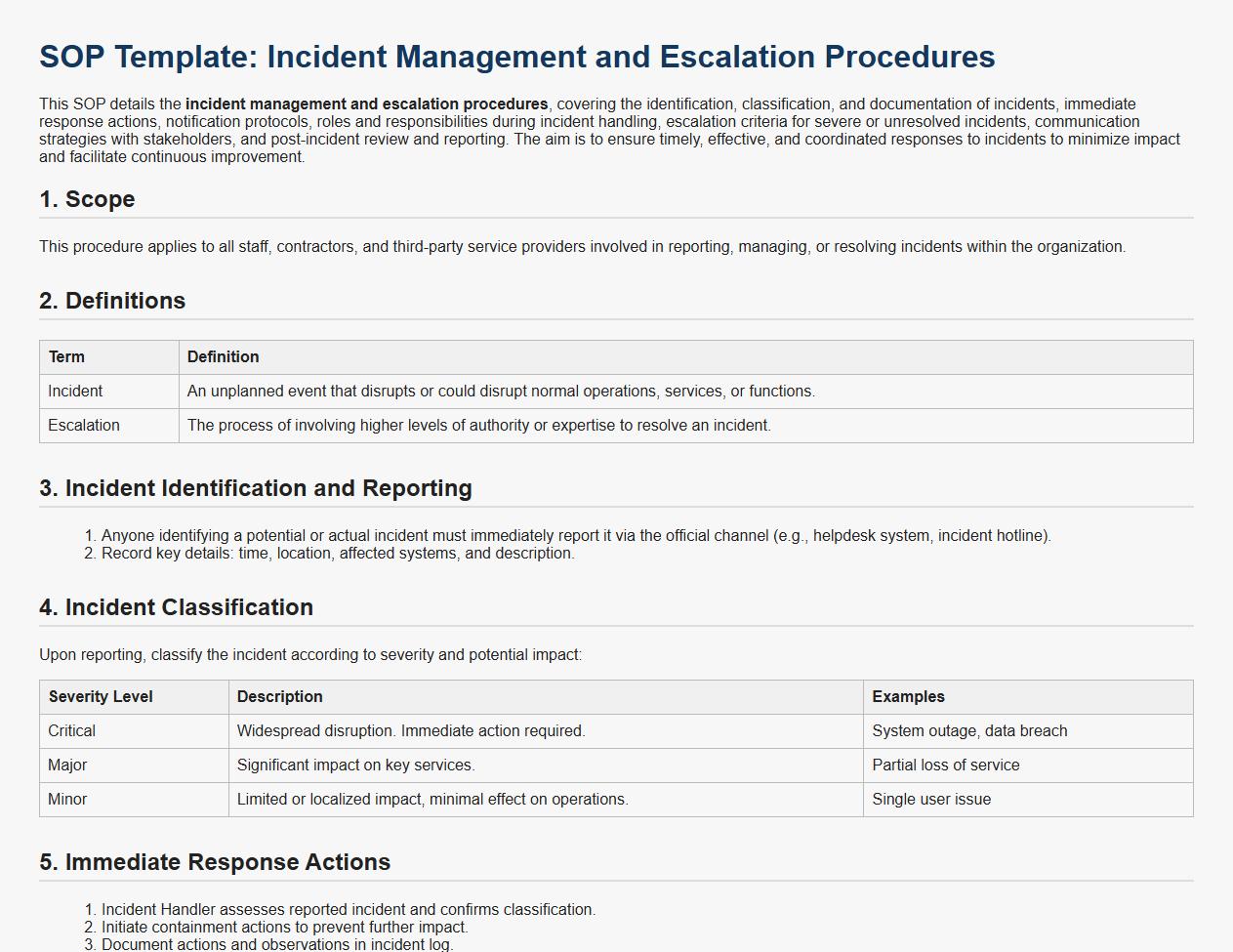
This SOP details the incident management and escalation procedures, covering the identification, classification, and documentation of incidents, immediate response actions, notification protocols, roles and responsibilities during incident handling, escalation criteria for severe or unresolved incidents, communication strategies with stakeholders, and post-incident review and reporting. The aim is to ensure timely, effective, and coordinated responses to incidents to minimize impact and facilitate continuous improvement.
Service Request Fulfillment Guidelines.
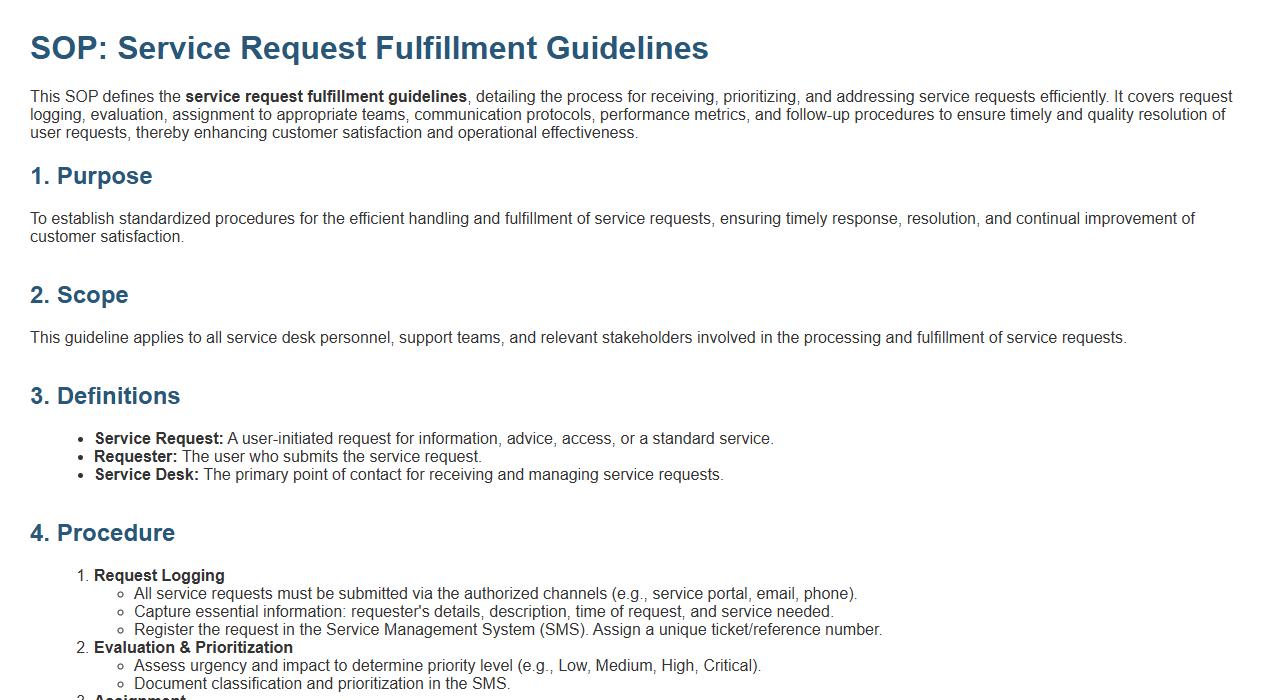
This SOP defines the service request fulfillment guidelines, detailing the process for receiving, prioritizing, and addressing service requests efficiently. It covers request logging, evaluation, assignment to appropriate teams, communication protocols, performance metrics, and follow-up procedures to ensure timely and quality resolution of user requests, thereby enhancing customer satisfaction and operational effectiveness.
Change Management Process and Documentation.
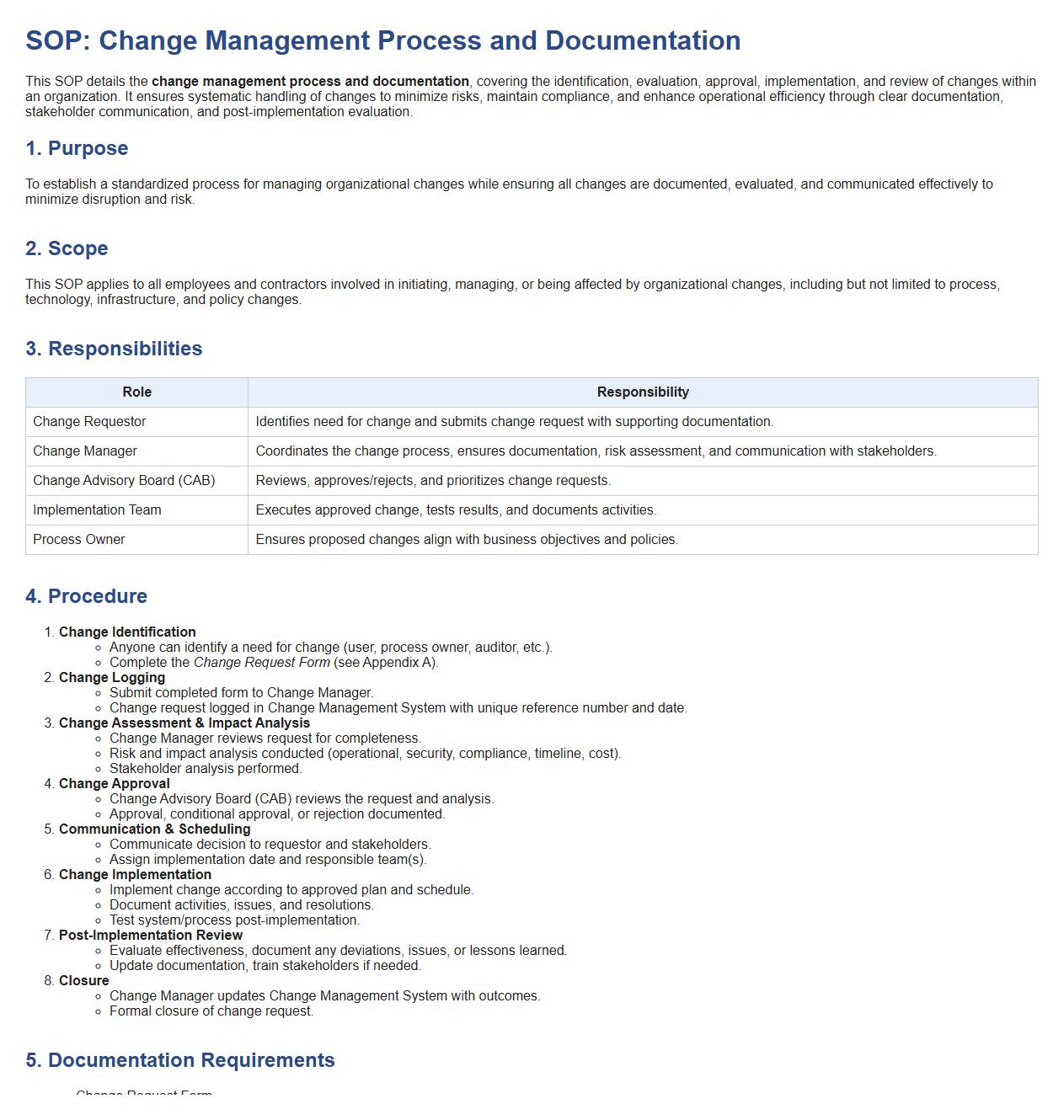
This SOP details the change management process and documentation, covering the identification, evaluation, approval, implementation, and review of changes within an organization. It ensures systematic handling of changes to minimize risks, maintain compliance, and enhance operational efficiency through clear documentation, stakeholder communication, and post-implementation evaluation.
Problem Management and Root Cause Analysis.
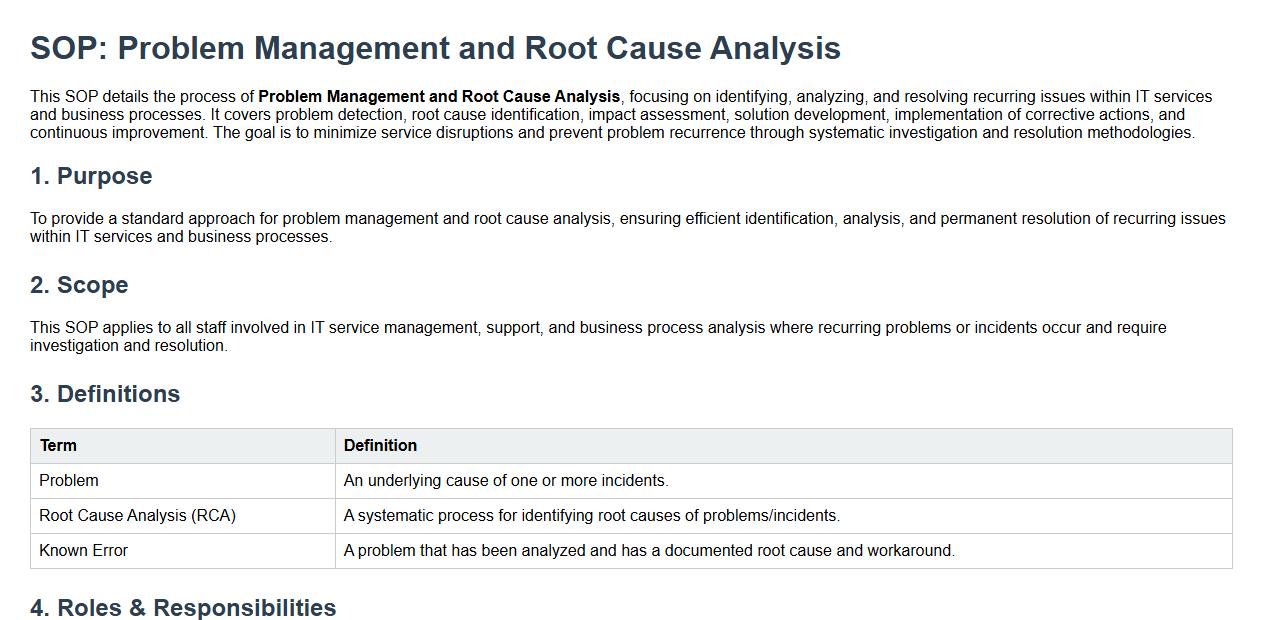
This SOP details the process of Problem Management and Root Cause Analysis, focusing on identifying, analyzing, and resolving recurring issues within IT services and business processes. It covers problem detection, root cause identification, impact assessment, solution development, implementation of corrective actions, and continuous improvement. The goal is to minimize service disruptions and prevent problem recurrence through systematic investigation and resolution methodologies.
Asset and Configuration Management Procedures.
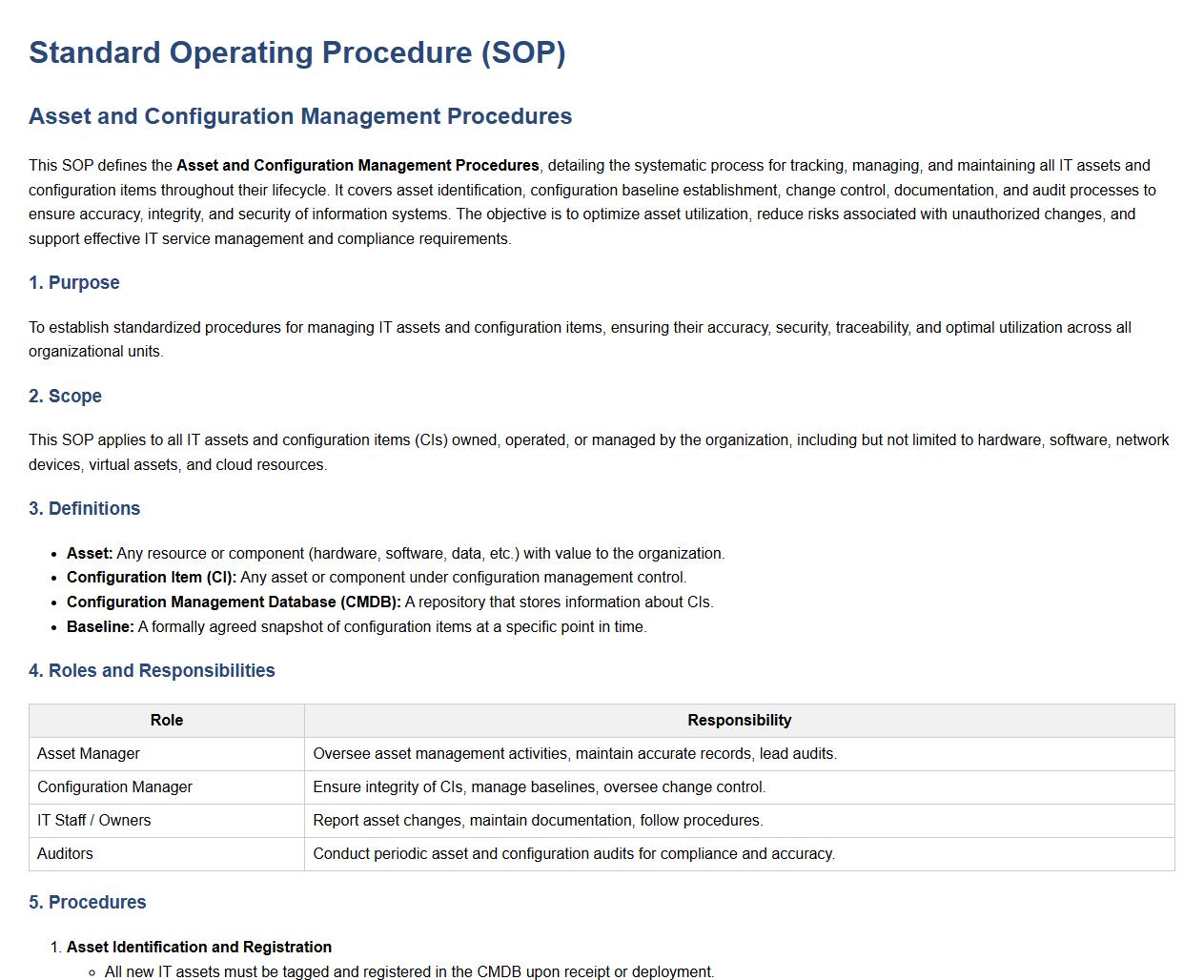
This SOP defines the Asset and Configuration Management Procedures, detailing the systematic process for tracking, managing, and maintaining all IT assets and configuration items throughout their lifecycle. It covers asset identification, configuration baseline establishment, change control, documentation, and audit processes to ensure accuracy, integrity, and security of information systems. The objective is to optimize asset utilization, reduce risks associated with unauthorized changes, and support effective IT service management and compliance requirements.
Access and Identity Management SOP.
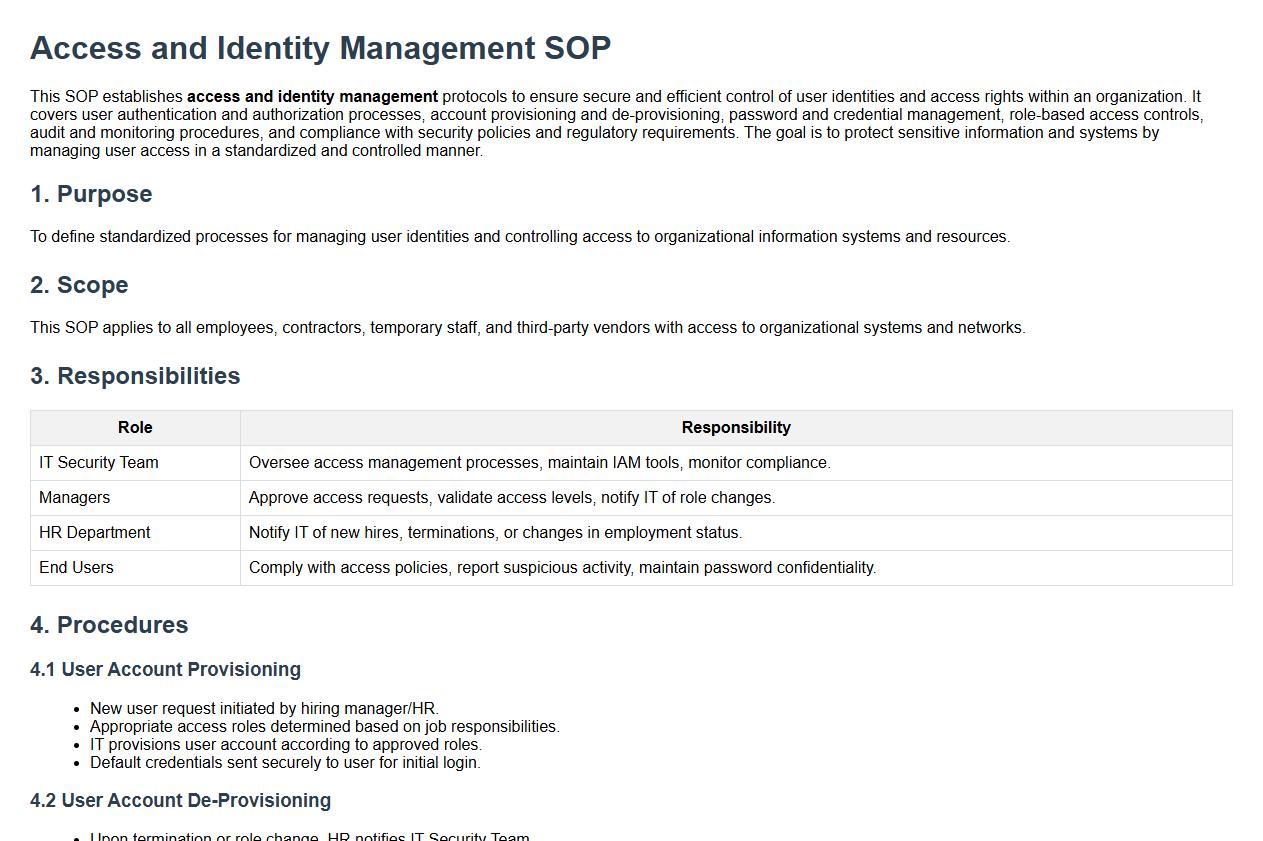
This SOP establishes access and identity management protocols to ensure secure and efficient control of user identities and access rights within an organization. It covers user authentication and authorization processes, account provisioning and de-provisioning, password and credential management, role-based access controls, audit and monitoring procedures, and compliance with security policies and regulatory requirements. The goal is to protect sensitive information and systems by managing user access in a standardized and controlled manner.
Release and Deployment Management Steps.
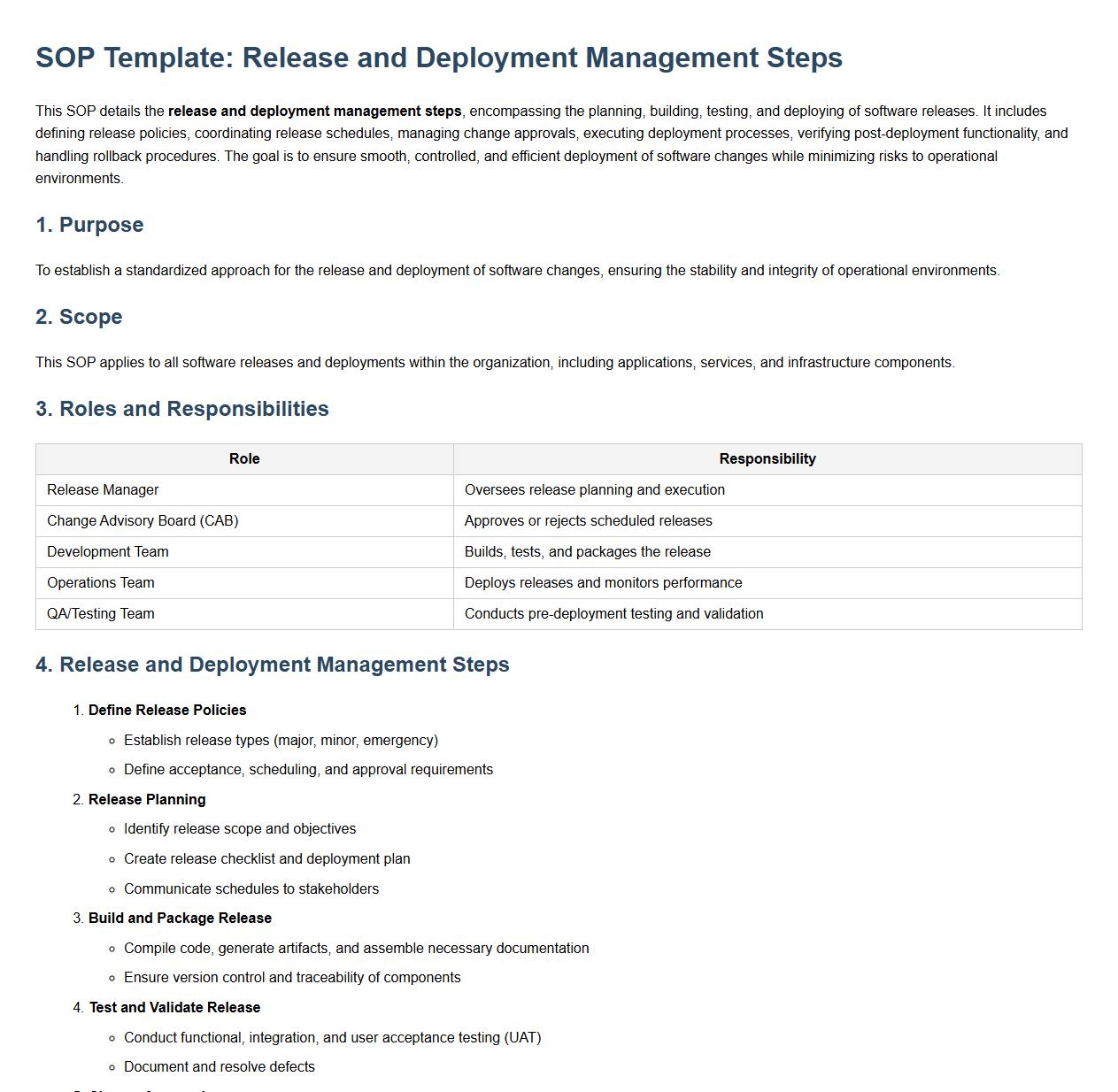
This SOP details the release and deployment management steps, encompassing the planning, building, testing, and deploying of software releases. It includes defining release policies, coordinating release schedules, managing change approvals, executing deployment processes, verifying post-deployment functionality, and handling rollback procedures. The goal is to ensure smooth, controlled, and efficient deployment of software changes while minimizing risks to operational environments.
Backup, Restore, and Data Recovery Procedures.
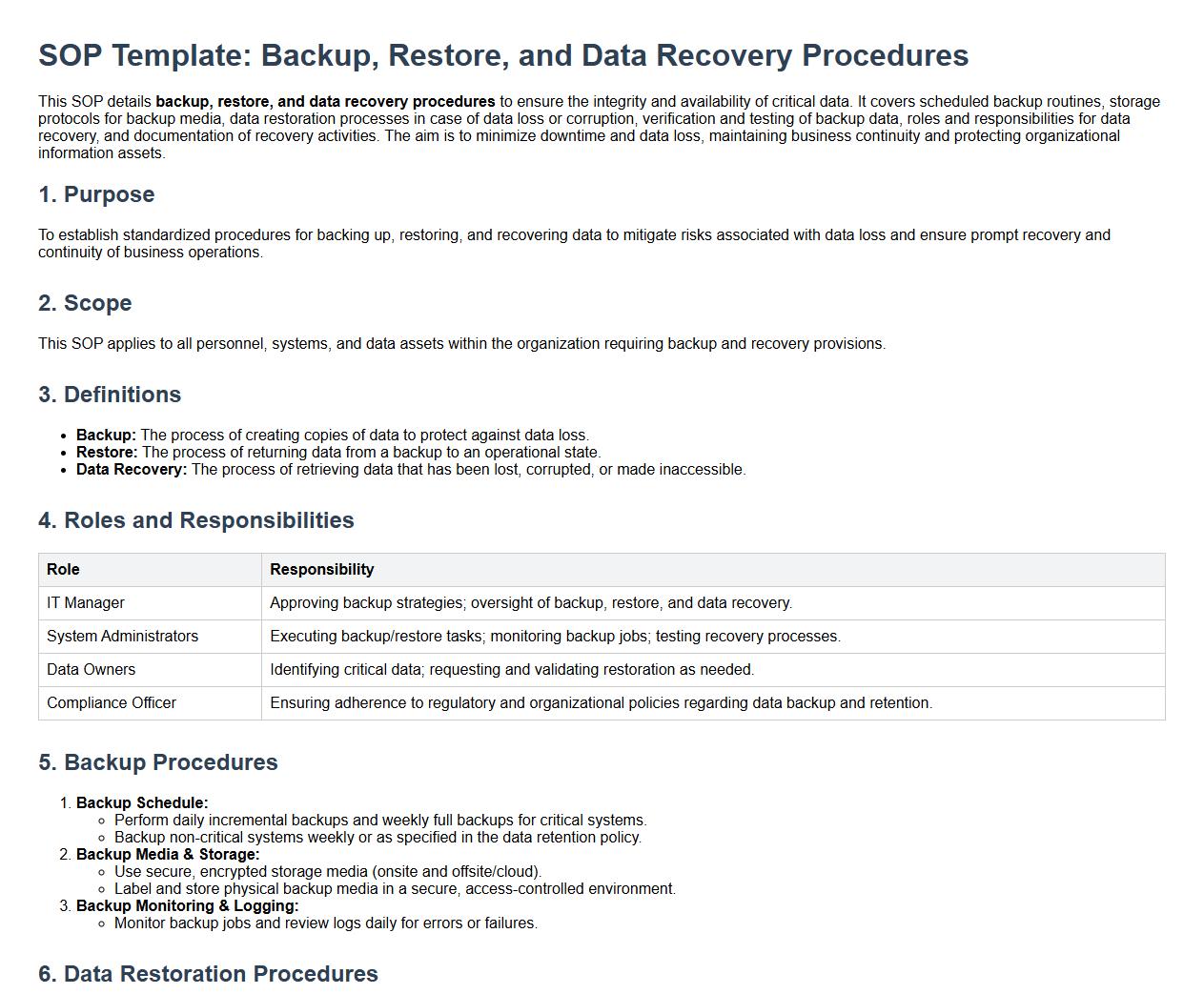
This SOP details backup, restore, and data recovery procedures to ensure the integrity and availability of critical data. It covers scheduled backup routines, storage protocols for backup media, data restoration processes in case of data loss or corruption, verification and testing of backup data, roles and responsibilities for data recovery, and documentation of recovery activities. The aim is to minimize downtime and data loss, maintaining business continuity and protecting organizational information assets.
IT Security Incident Response Workflow.
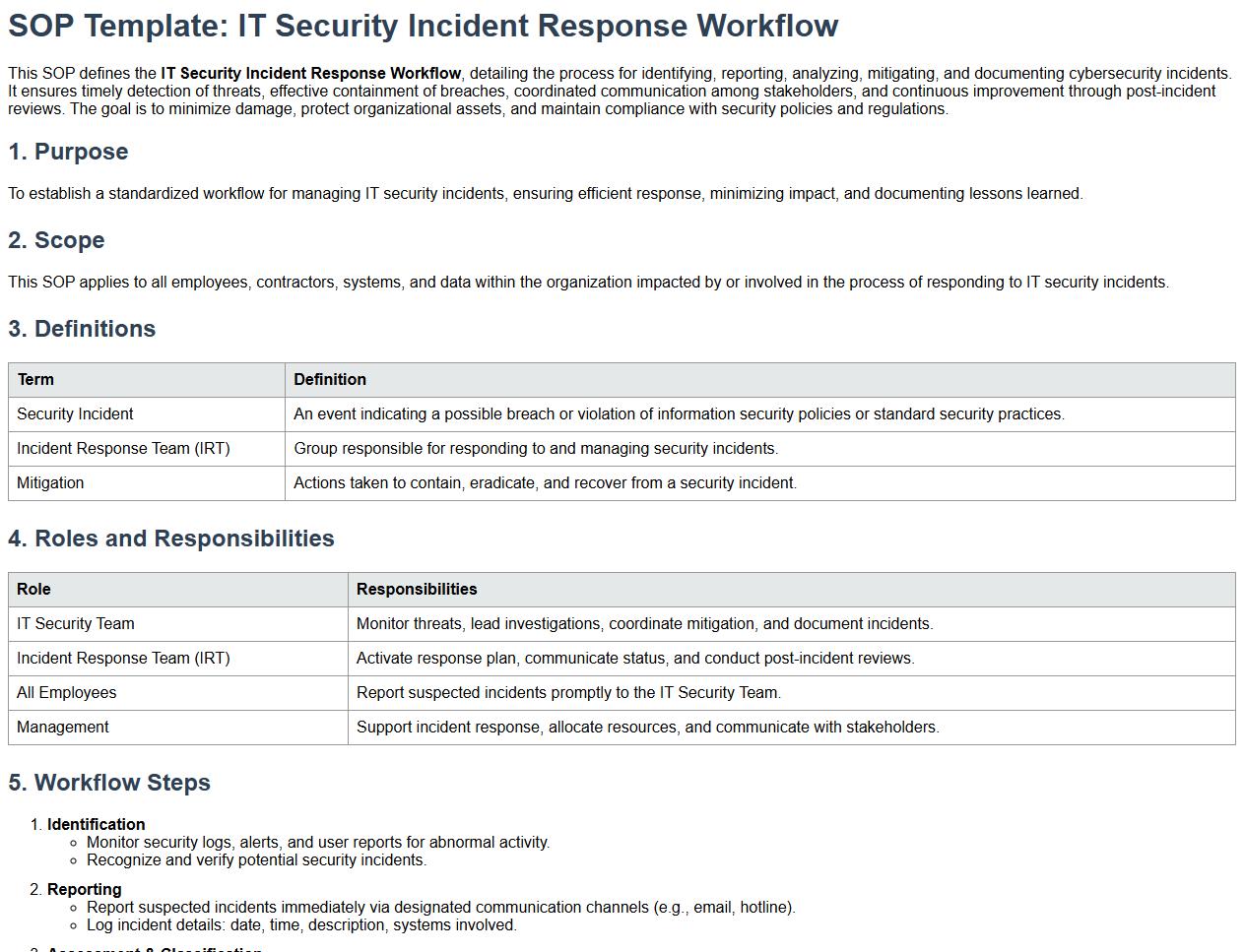
This SOP defines the IT Security Incident Response Workflow, detailing the process for identifying, reporting, analyzing, mitigating, and documenting cybersecurity incidents. It ensures timely detection of threats, effective containment of breaches, coordinated communication among stakeholders, and continuous improvement through post-incident reviews. The goal is to minimize damage, protect organizational assets, and maintain compliance with security policies and regulations.
Service Level Agreement (SLA) Monitoring and Reporting.
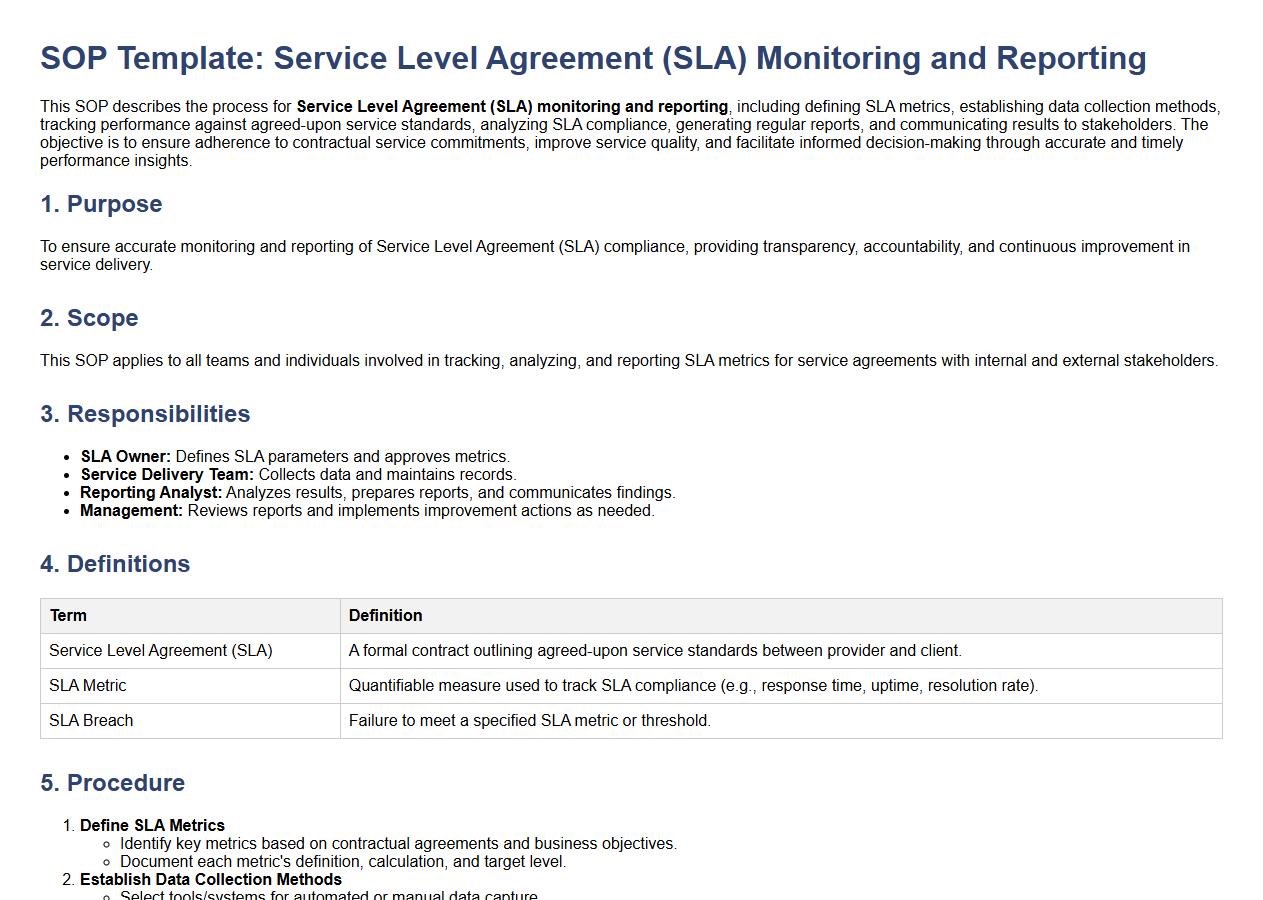
This SOP describes the process for Service Level Agreement (SLA) monitoring and reporting, including defining SLA metrics, establishing data collection methods, tracking performance against agreed-upon service standards, analyzing SLA compliance, generating regular reports, and communicating results to stakeholders. The objective is to ensure adherence to contractual service commitments, improve service quality, and facilitate informed decision-making through accurate and timely performance insights.
What is the primary objective of the IT Service Management SOP?
The primary objective of the IT Service Management SOP is to ensure consistent and efficient delivery of IT services across the organization. It aims to align IT services with business needs and improve overall service quality. This SOP establishes standardized procedures to minimize service disruptions and enhance user satisfaction.
Which roles and responsibilities are defined in the IT Service Management SOP?
The SOP clearly defines roles and responsibilities for IT staff, service managers, and support teams to maintain accountability. It outlines who is responsible for incident resolution, problem management, and service delivery oversight. This clarity helps ensure timely responses and effective collaboration among stakeholders.
What processes are outlined for incident and problem management in the SOP?
The SOP outlines structured incident and problem management processes to quickly restore normal service operations and identify root causes. Incident management focuses on prompt resolution and user communication, while problem management aims to prevent recurrence through thorough investigation. Both processes include logging, categorization, prioritization, and resolution steps.
How does the SOP address documentation and record-keeping requirements?
The SOP mandates comprehensive documentation and record-keeping to ensure transparency and accountability in IT service management. It requires maintaining accurate logs of incidents, changes, and resolutions for audit and continuous improvement purposes. Proper documentation supports compliance, knowledge sharing, and decision-making.
What are the escalation procedures specified in the IT Service Management SOP?
The SOP defines clear escalation procedures to handle incidents and problems that require higher-level intervention or faster resolution. It specifies triggers for escalation, such as unresolved issues beyond set timeframes or critical impact. This structured approach ensures timely support from senior technical or management personnel.